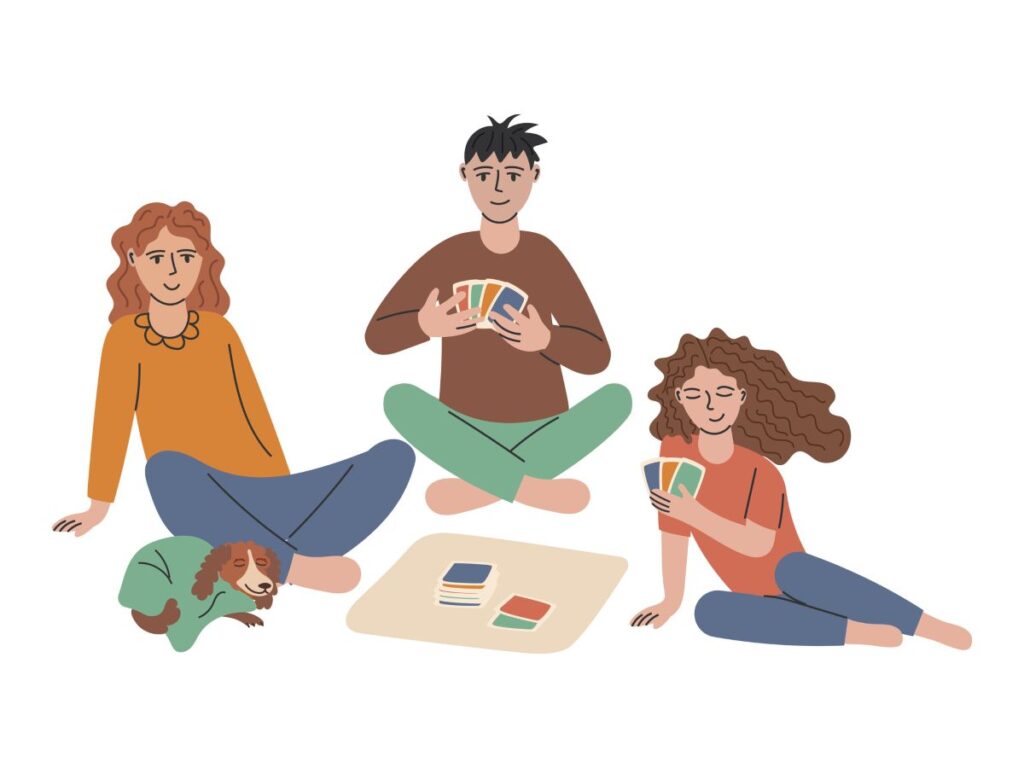
Once upon a time I had a little brother, and he loved stories, sat in odd curled-up positions, wrote poetry, told random jokes, was generally cheerful and thoughtful of others, married an artist, built himself and his beloved a sweet little cabin in the woods, decided to get his MA in marriage and family counseling…and oh, yeah, I’m not supposed to be reviewing the brother, but the game he designed.
It’s called Pathos, and it is designed to help you and your family or friends talk about emotions.
You can do this seriously or lightheartedly, but I guarantee you will have an interesting conversation and come away knowing each other just a little bit better. The game is simple and similar to Uno: everyone gets six cards and play proceeds in a circle. When it’s your turn, lay a card that matches either the color or symbol of the card on top of the stack. Answer the question on the card that you lay. Once in a while, the cards have special directions such as reverse turn directions or trade places with another player. Examples of some questions you might encounter:
- What helps you show love?
- Describe anger as a landscape.
- What is one positive of anxiety?
- If love were a house, what would it look like?
- Tell about a time you felt angry.
- What is one lie about happiness?
My experience: I’ve played this game with different groups, and some felt more comfortable than others, as you might expect in a game about discussing emotions. I like best to play it as a game/discussion forum, where everyone takes their turn to lay a card and answer the question on it, but others are free to chime in to give their own answer or discuss the question with the person whose turn it is. I like to tell everyone up front that this is how we will play it, so that people feel free to engage in discussion while playing.
And while the game instructions suggest that players be vulnerable with their answers, I’ve found I prefer to tell people: “Don’t overthink your answers and just share what you feel comfortable with.” Because there is no doubt some of us find it easier to express our emotions than others, and a group setting might not be the easiest place for some people to begin. That being said, the questions are simple and open ended and easy to use to step into discussions. Anyone can play this game!
I wish I had taken pictures of game play in session! Not only did I neglect to take pictures, I loaned the game out to a friend, so I can’t quickly run and snap a few to show you. Never mind, you can check out the pictures and the description video on Amazon.
Chad’s wife Sharla painted the very emotional kitties that decorate the game cards. She is a talented artist who recently won 1st place at the Banbury Art Crawl. You can see more of her work on her website. And here’s a photo of the two of them.

And another of my brother when he visited a year or so ago, eating a giant ice cream from Saffitickers:

Probably what I most look forward about playing Pathos in years to come is playing with my children and hearing them talk about their emotions and giving them an outlet to express their ideas and feelings to me.
Although it must be admitted they haven’t showed any reticence in that regard up to this point. When I try to tell Teddy, the two-year-old, to calm down about something, he tells me, weeping loudly, “But Mom, I’m sad!” Translated: I have a right to be crying! And when he doesn’t like a no answer I’ve given, he tells me, “I’m mad at you, Mom.”
If we keep this openness about emotions into teenagerhood, I’ll probably consider it a win.
***
My brother gifted me with a game in exchange for my review. Header illustration by :Ekaterina Buravleva on istock.